

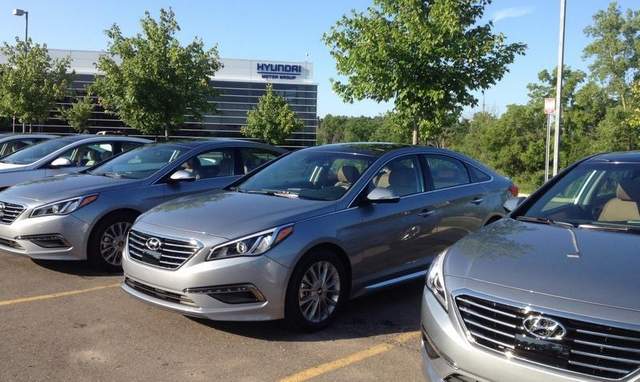
The seventh-generation 2015 Hyundai Sonata can’t rest on critical laurels of an outgoing model that created a new standard for styling in a relatively bland segment when it debuted in 2010.
The all-new 2015 Sonata must compete in a midsize car segment with a renewed emphasis on style, exemplified by the Ford Fusion and Nissan Altima, and a consumer appetite for reliability and value associated with the Toyota Camry, said Mike O’Brien, Hyundai vice president of product planning.
“This is the most important product for us,” O’Brien said. “As Sonata goes, so does Hyundai.”
The outgoing model did well with those who wanted aggressive design, not as well with those who prioritized affordability and value. Last year, Hyundai sold almost 204,000 Sonatas, down 12%, compared with more than 480,000 Camrys, 367,000 Honda Accords and 295,000 Fusions.
Hyundai’s solution: three versions for 2015. There is a fuel-efficient model with a 1.6-liter turbocharged engine and seven-speed dual-clutch transmission offering more value, a volume model with a 2.4-liter four-cylinder that is more sophisticated and a sport model with a turbocharged 2-liter engine for those wanting a more aggressive look and drive.
The 2.4-liter model went on sale at the end of May, the 2-liter goes on sale later this month, the Eco version will be on sale by September and a hybrid will come a year from now with a new hybrid system.
Pricing starts at $21,150, which is $300 less than the outgoing model and beats the competition by about $1,700. The top-of-the-line Sport Unlimited is $33,525.
Sonata becomes the widest car in the segment. Not offering a V6 again allowed designers to convert engine space to cabin space. As a result, the Sonata’s interior space qualifies as a full-size sedan (think Ford Taurus, Chevrolet Impala, Nissan Maxima) according to the Environmental Protection Agency.
The Sonata and Elantra sedans are made in Montgomery, Ala., at a plant with original capacity to make 300,000 cars annually, but stretched to almost 400,000 last year with a third shift and overtime, said manager of product planning John Shon.
Hyundai also imports from South Korea about a third of the Elantras (including the hatchback and coupe) sold here. The automaker is looking to import even more this year so it can make more Sonatas here. Currently the mix in Alabama is half Sonata, half Elantra, Shon said.
Even with many buyers gravitating to crossovers, the midsize car segment has stabilized at about 2.4 million vehicles in the U.S. compared with 1.6 million when Hyundai was launching the outgoing model, O’Brien said.
Most of Hyundai’s growth is from the Santa Fe and Tucson but 60% of sales are the Sonata and Elantra sedans, he said.
Hyundai had a record sales month in June of more than 70,000 and is ahead of plan halfway through the year.


